
Circular Tayside Charter

Welcome to the Circular Tayside Charter, the purpose of our charter is to provide business goals for your specific sector of industry aiming to improve your green scheme and acknowledge your efforts with environmental credentials.
What is the Charter?
The Circular Economy Assessment programme designed by the Circular Tayside Ambassadors in collaboration Dundee and Angus Chamber of Commerce, Perthshire Chamber of Commerce, Zero Waste Scotland to benchmark your performance and set personal goals for your business
What is Circular Economy?
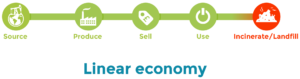
Circular Economy is an alternative economic system to the linear model we have been operating under until now. In our current model, virgin materials are extracted from finite earth resources, they are used in manufacturing processes to create products that are then sold, used and ultimately incinerated for energy recovery or landfilled. This economic model is not sustainable and is already causing price instability of virgin resources in the global market and great negative environmental externalities. It is not good for the environment and it is also not good for business.
The Circular Economy is a truly sustainable alternative to the linear ma last resort, to be easily recycled (for example made from one or two materials).Disposal is not an option as every material disposed of is a raw material lost.
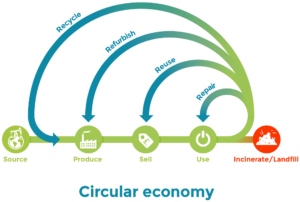
In a Circular Economy virgin material use is decoupled from profit, ownership is decoupled from wellbeing, “waste” is identified as a resource, and profit is generated through sophisticated product design in conjunction with robust business models that keep materials in use for as long as possible, to the highest quality possible. For more information on Circular Economy vs Linear Economy check here.
Why should your business care?
By using materials that already exist you can have increased price and resource stability. You can even retain control of your resources with the appropriate business model
Specific improvements can include:
-Cost savings through more efficient resource use and reusing, repairing, refurbishing products and materials.
-Implementation of new business models.
- Development of new product lines, to extract value from waste which cannot be eliminated, by-products and co-products.
-Greater customer satisfaction building brand loyalty and providing new products or services
-Reduced supply chain risks through less exposure to volatile commodity prices and resource supply risks
Lastly, circular economy is adopted by the whole of EU as well as Scotland and promoted through funding and legislation. Increasing the circularity of your business will make you more desirable to local and overseas clients, whether they are end users, other businesses or authorities.
How does the Charter Work?
There are two compulsory commitments and four elective ones. The compulsory commitments must be met by all signatories, and they must choose to progress in at least one of the electives.
The three levels are bronze, silver and gold, with an exceptional platinum for any organisation that is Cradle-2-Cradle certified . The overall level awarded is equal to the lowest level achieved in one of the categories. Every organisation is asked to commit to achieving a minimum of bronze level in the two compulsory categories and in one elective category. Once you have committed to a goal, you will set a self-directed timescale for completion and onward progression to the next category(ies).
The process for receiving an award is as follows:
- Read Circular Tayside Charter- Introduction
- Read Circular Tayside Charter- Guide
- Meet with key staff in your organisation to discuss the different categories and assess which ones are most relevant for you at the moment
- Fill in the Charter
- If you already meet the minimum requirements to sign for the charter, fill the details and submit for review. You will be asked to arrange for a chat with the Circular Tayside Team within 3 weeks of your submission and will be notified with the results shortly after that.
- If you don’t meet the minimum requirements yet, fill the details and describe briefly how you will work towards receiving the award of the category you have committed to. Once you send us this information, your organisation will be classed as “working towards an accreditation”.
- Report your progress whenever your organisation is ready to receive a new award. Please fill in the fields and send them to Circular Tayside. You will be asked to arrange for a chat with the Circular Tayside Officer within 3 weeks of your submission and will be notified with the results shortly after that.
For any questions on any of the above, please contact Circular Tayside.
You should choose the most relevant elective category and attainment level for your organisation and share any relevant information that will help with our decision. You should upload any relevant documents i.e Circularity measuring report for baseline and new status, Green Champions Certificates, proof for 2.2 Bronze and Silver, proof for 2.3 bronze and proof for 2.4 bronze and 2.4 gold.
The award you will receive will be equal to the minimum level achieved.
Accreditation is only given for 1 year and you are expected to report on how you have improved in the categories of your choice. If you have received a Gold award and you have not improved in the year, your status will go down to silver.
Resources to be used for this charter are:
1.1 Circularity measuring tool e.g. the CTI Tool, the AyMa IoT’s software platform, IPSUM, the MDG Group Triple A Plan and carbon footprint calculator
1.2 Bronze: Introductory CE video and self assessed carbon footprint
1.2 Gold: Green Champions Training
2.1 Bronze and Gold: CO2 measuring tool i.e. Idemat
2.4 Bronze: Circular Office Checklist
2.4 Silver: Green Office Guide
1. Compulsory
These two commitments must be undertaken by all in order to sign up for the charter.
1.1 First Compulsory| Ongoing Monitoring and Assessment
Our organisation commits to regularly monitor and assess the organisations’ circularity, with the intention of continuously improving it.
Transitioning from a linear to a circular model is an ongoing process that depends on internal-organisational factors, as well as external-market opportunities. By signing up for this charter your organisation commits to continue this journey towards a more circular future. There are various tools that can help you measure your circularity, i.e. CTI Tool can help keep track of your company's performance, to measure your baseline and your annual progress.
1.2 Second Compulsory| Staff Engagement
Our organisation commits to have key staff trained in circular economy practices, to help the organisation transition from linear to circular.
Circular Economy requires systemic change, and that is possible only if relevant key staff in your organisation are on board for the transition from linear to circular. Circular Tayside can provide free online or in person training to introduce the Circular Economy to your staff.
Bronze- Relevant key staff from our organisation have registered and viewed Zero Waste Scotland online introductory circular economy video to understand the basic principles
Silver- Key staff have attended an exploratory session with the Circular Tayside Team or attended a sector specific workshop.
Gold- Key staff have received Green Champions training and certificates on the 3 waste-related practical modules or Climate Solutions Accelerator and Environmental Awareness training for certificates. We also commit to enable our staff to continuously increase their knowledge and improve the organisation's practices.
2. Electives
Choose at least one from the Electives
2.1 First Elective| Supply Chain Engagement
Sector: All except for service providers.
We commit to introduce our supply chain to Circular Economy, which will make their and our operations more circular, easier and faster, while reducing our CO2 footprint.
Circular Economy is not something that can be achieved by one individual, company or area. It requires a systemic effort to deliver zero waste and zero virgin resource use, and keep materials in circulation at the highest quality and value possible. Also, by adopting circular economy practices, end users needs are decoupled from continuous extraction and advanced manufacturing of new products, a practice that can bring CO2 emissions down by up to 40%. This brings your business in line with the Scottish Government’s net zero CO2 target by 2045.
Engaging your supply chain is therefore an important part of embedding circularity into your operations and realising the benefits it can bring .
A relatively easy and free CO2 calculator you can use is a phone app called Idemat.
Bronze-We have created a policy and made our suppliers aware that we are part of this charter, are looking to reduce our carbon footprint, and that we are also looking for our suppliers to reduce their carbon footprint.
Silver We have 20% of our suppliers that recognise our policy and have regular structured conversations about potential ways suppliers can reduce their carbon footprint. We have referred them to the Energy Efficiency Business Support Service.
Gold: We have conducted a review of exiting suppliers/policies/products/services and consider switching suppliers to one that is more inline with CE principles Where possible, we have encouraged our suppliers to sign up for the Circular Tayside Charter.
2.2. Second Elective| Circular Product Design
Sector: Manufacturing
I commit to reduce use of virgin resources and production of waste, while reducing my CO2 emissions.
The majority of manufacturers today follow a linear model. Virgin resources are used and waste is generated that is at best recycled and at worst incinerated and landfilled. Recycling is not a panacea since it requires effort and energy to take place, and should only be used if other options are exhausted (Take a look at the waste hierarchy that can guide you). For that reason, we are asking all manufacturers and product designers to rethink their products.
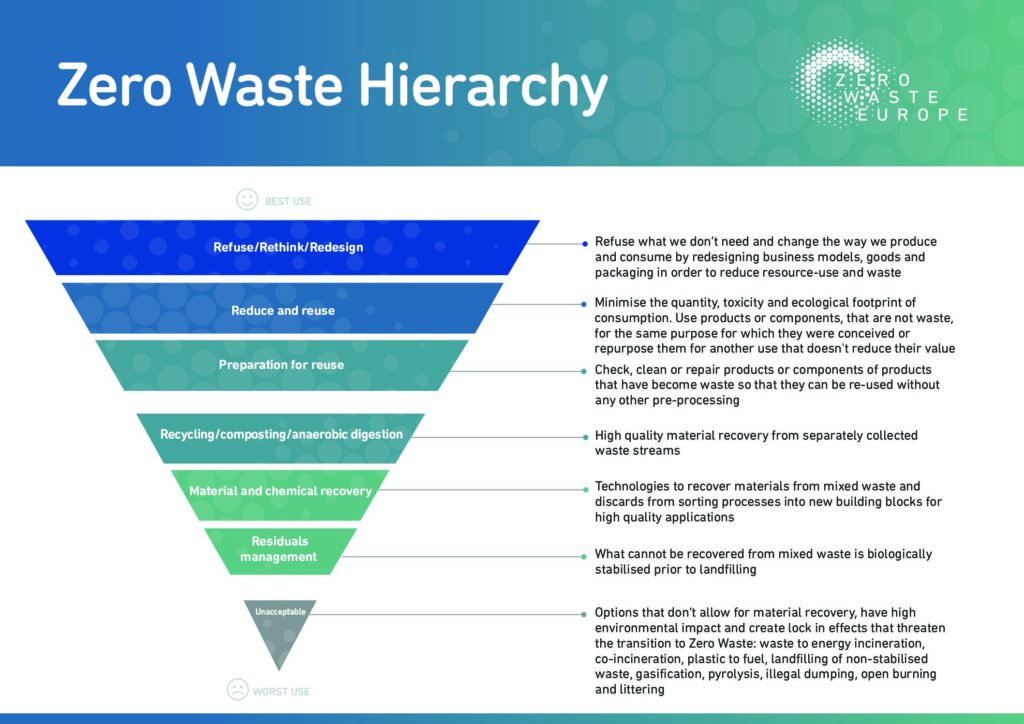
There are many ways that can make your product more circular
Whatever your product is, there is a solution to make it more circular, while keeping your profit margin intact, or even increasing it.
Bronze- Key staff have participated in a Circular Canvas session where waste and wasted resources have been identified, as well as explored circular products. We have left the session with ideas and ways to explore them
Silver- Whenever we distribute our product, we include directions on how it should be fixed, reused, used alternatively or as a last resort, recycled, based on the waste hierarchy.
Gold- We have optimised and re-designed an element of our product with its end in mind. We worked down the waste hierarchy, by reducing or eliminating the amount of packaging, designing our product to be easily reused, fixed, remanufactured or as a last resort, taken apart in its components and recycled. Lastly, we are aiming for local suppliers and commit to increase the amount non-virgin resources use as much as possible.
Platinum- We have become Cradle-2-Cradle certified
2.3 Third Elective| Circular Business Model
Sector: Manufacturing, retail, product providers.
Our organization will adopt a Circular Business Model, that will increase resource security and reduce waste while maximizing profit
Circular economy business models keep products and materials in use, by design, for as long, to the highest value state possible to get the maximum value from them. They decouple product sells from profit by adopting the principles and revenue-generating potential of Hiring and Leasing, Performance / Service Systems, Incentivised Return, Asset Management, Collaborative Consumption and Long Life. Circular Business Models work best when combined with circular products. For example a product may be designed to last a long time, easily disassembled, containing easily fixable components. The product is leased for an agreed amount of time, returned, any faulty components are fixed rather replaced, it is reassembled quickly and leased again. Some examples can be found here
Bronze- Key staff have participated in a Circular Canvas session where waste and wasted resources have been identified, as well as explored circular business models. We have left the session with ideas and ways to explore them.
Silver- We have implemented some changes towards a circular business model
Gold- The organization has a fully fledged/functional circular business model, that is being reassessed and improved continuously. We have identified the elements and materials we can control and we aim to increase
their circularity.
2.4 Fourth Elective| Circular Office
Sector: Service providers
We commit to continuously review our operations and make them more circular
The way we operate in our offices says a lot about our organisation. Being circular requires more than recycling, it requires taking a step back, viewing the needs of the users of the office and finding sophisticated ways of meeting them. By signing up for this charter your organisation commits to take the time and redesign its operations. There are many available models, for example sharing resources, dematerialising products through digitalisation, work-from-home schemes, acquiring products with their circularity in mind (easily disassembled, fixed, recycled, long-life etc), finding alternatives to disposal when products are not useful for your organisation anymore and many others. Some examples can be found here and here
Bronze- Key staff have reviewed the following document and applied business appropriate measures
Silver- Key staff have reviewed this guide and attended a session with the Circular Tayside Team to explore the creation of a circular economy team or the training of the sustainability team to understand circularity, and created a circular strategy for our office.
Gold- We have implemented an action plan that derived from the previous two levels and can demonstrate our waste savings. We have a stated aim of continuous improvement.
How does the Charter Work?
There are two compulsory commitments and four elective ones. The compulsory commitments must be met by all signatories, and they must choose to progress in at least one of the electives.
The three levels are bronze, silver and gold, with an exceptional platinum for any organisation that is Cradle-2-Cradle certified . The overall level awarded is equal to the lowest level achieved in one of the categories. Every organisation is asked to commit to achieving a minimum of bronze level in the two compulsory categories and in one elective category. Once you have committed to a goal, you will set a self-directed timescale for completion and onward progression to the next category(ies).
The process for receiving an award is as follows:
- Read Circular Tayside Charter- Introduction
- Read Circular Tayside Charter- Guide
- Meet with key staff in your organisation to discuss the different categories and assess which ones are most relevant for you at the moment
- Fill in the Charter
- If you already meet the minimum requirements to sign for the charter, fill the details and submit for review. You will be asked to arrange for a chat with the Circular Tayside Team within 3 weeks of your submission and will be notified with the results shortly after that.
- If you don’t meet the minimum requirements yet, fill the details and describe briefly how you will work towards receiving the award of the category you have committed to. Once you send us this information, your organisation will be classed as “working towards an accreditation”.
- Report your progress whenever your organisation is ready to receive a new award. Please fill in the fields and send them to Circular Tayside. You will be asked to arrange for a chat with the Circular Tayside Officer within 3 weeks of your submission and will be notified with the results shortly after that.
For any questions on any of the above, please contact Circular Tayside.
You should choose the most relevant elective category and attainment level for your organisation and share any relevant information that will help with our decision. You should upload any relevant documents i.e Circularity measuring report for baseline and new status, Green Champions Certificates, proof for 2.2 Bronze and Silver, proof for 2.3 bronze and proof for 2.4 bronze and 2.4 gold.
The award you will receive will be equal to the minimum level achieved.
Accreditation is only given for 1 year and you are expected to report on how you have improved in the categories of your choice. If you have received a Gold award and you have not improved in the year, your status will go down to silver.
Resources to be used for this charter are:
1.1 Circularity measuring tool e.g. the CTI Tool, the AyMa IoT’s software platform, IPSUM, the MDG Group Triple A Plan and carbon footprint calculator
1.2 Bronze: Introductory CE video and self assessed carbon footprint
1.2 Gold: Green Champions Training
2.1 Bronze and Gold: CO2 measuring tool i.e. Idemat
2.4 Bronze: Circular Office Checklist
2.4 Silver: Green Office Guide
Bronze
These two commitments must be undertaken by all in order to sign up for the charter.
1.1 First Compulsory| Ongoing Monitoring and Assessment
Our organisation commits to regularly monitor and assess the organisations’ circularity, with the intention of continuously improving it.
Transitioning from a linear to a circular model is an ongoing process that depends on internal-organisational factors, as well as external-market opportunities. By signing up for this charter your organisation commits to continue this journey towards a more circular future. There are various tools that can help you measure your circularity, i.e. CTI Tool can help keep track of your company's performance, to measure your baseline and your annual progress.
1.2 Second Compulsory| Staff Engagement
Our organisation commits to have key staff trained in circular economy practices, to help the organisation transition from linear to circular.
Circular Economy requires systemic change, and that is possible only if relevant key staff in your organisation are on board for the transition from linear to circular. Circular Tayside can provide free online or in person training to introduce the Circular Economy to your staff.
Silver
These two commitments must be undertaken by all in order to sign up for the charter and receive the silver award.
1.1 First Compulsory| Ongoing Monitoring and Assessment
Our organisation commits to regularly monitor and assess the organisations’ circularity, with the intention of continuously improving it.
Transitioning from a linear to a circular model is an ongoing process that depends on internal-organisational factors, as well as external-market opportunities. By signing up for this charter your organisation commits to continue this journey towards a more circular future. There are various tools that can help you measure your circularity, i.e. CTI Tool can help keep track of your company's performance, to measure your baseline and your annual progress.
1.2 Second Compulsory| Staff Engagement
Our organisation commits to have key staff trained in circular economy practices, to help the organisation transition from linear to circular.
Circular Economy requires systemic change, and that is possible only if relevant key staff in your organisation are on board for the transition from linear to circular. Circular Tayside can provide free online or in person training to introduce the Circular Economy to your staff.
Silver- Key staff have attended an exploratory session with the Circular Tayside Team or attended a sector specific workshop.
- Electives
Choose at least one from the Electives
2.1 First Elective| Supply Chain Engagement
Sector: All except for service providers.
We commit to introduce our supply chain to Circular Economy, which will make their and our operations more circular, easier and faster, while reducing our CO2 footprint.
Circular Economy is not something that can be achieved by one individual, company or area. It requires a systemic effort to deliver zero waste and zero virgin resource use, and keep materials in circulation at the highest quality and value possible. Also, by adopting circular economy practices, end users needs are decoupled from continuous extraction and advanced manufacturing of new products, a practice that can bring CO2 emissions down by up to 40%. This brings your business in line with the Scottish Government’s net zero CO2 target by 2045.
Engaging your supply chain is therefore an important part of embedding circularity into your operations and realising the benefits it can bring .
A relatively easy and free CO2 calculator you can use is a phone app called Idemat.
Silver We have 20% of our suppliers that recognise our policy and have regular structured conversations about potential ways suppliers can reduce their carbon footprint. We have referred them to the Energy Efficiency Business Support Service.
2.2. Second Elective| Circular Product Design
Sector: Manufacturing
I commit to reduce use of virgin resources and production of waste, while reducing my CO2 emissions.
The majority of manufacturers today follow a linear model. Virgin resources are used and waste is generated that is at best recycled and at worst incinerated and landfilled. Recycling is not a panacea since it requires effort and energy to take place, and should only be used if other options are exhausted (Take a look at the waste hierarchy that can guide you). For that reason, we are asking all manufacturers and product designers to rethink their products.
There are many ways that can make your product more circular
Whatever your product is, there is a solution to make it more circular, while keeping your profit margin intact, or even increasing it.
Silver- Whenever we distribute our product, we include directions on how it should be fixed, reused, used alternatively or as a last resort, recycled, based on the waste hierarchy.
2.3 Third Elective| Circular Business Model
Sector: Manufacturing, retail, product providers.
Our organization will adopt a Circular Business Model, that will increase resource security and reduce waste while maximizing profit
Circular economy business models keep products and materials in use, by design, for as long, to the highest value state possible to get the maximum value from them. They decouple product sells from profit by adopting the principles and revenue-generating potential of Hiring and Leasing, Performance / Service Systems, Incentivised Return, Asset Management, Collaborative Consumption and Long Life. Circular Business Models work best when combined with circular products. For example a product may be designed to last a long time, easily disassembled, containing easily fixable components. The product is leased for an agreed amount of time, returned, any faulty components are fixed rather replaced, it is reassembled quickly and leased again. Some examples can be found here
Silver- We have implemented some changes towards a circular business model
2.4 Fourth Elective| Circular Office
Sector: Service providers
We commit to continuously review our operations and make them more circular
The way we operate in our offices says a lot about our organisation. Being circular requires more than recycling, it requires taking a step back, viewing the needs of the users of the office and finding sophisticated ways of meeting them. By signing up for this charter your organisation commits to take the time and redesign its operations. There are many available models, for example sharing resources, dematerialising products through digitalisation, work-from-home schemes, acquiring products with their circularity in mind (easily disassembled, fixed, recycled, long-life etc), finding alternatives to disposal when products are not useful for your organisation anymore and many others. Some examples can be found here and here
Silver- Key staff have reviewed this guide and attended a session with the Circular Tayside Team to explore the creation of a circular economy team or the training of the sustainability team to understand circularity, and created a circular strategy for our office.
Compulsory
Gold Award
1. Compulsory
These two commitments must be undertaken by all in order to sign up for the charter.
1.1 First Compulsory| Ongoing Monitoring and Assessment
Our organisation commits to regularly monitor and assess the organisations’ circularity, with the intention of continuously improving it.
Transitioning from a linear to a circular model is an ongoing process that depends on internal-organisational factors, as well as external-market opportunities. By signing up for this charter your organisation commits to continue this journey towards a more circular future. There are various tools that can help you measure your circularity, i.e. CTI Tool can help keep track of your company's performance, to measure your baseline and your annual progress.
1.2 Second Compulsory| Staff Engagement
Our organisation commits to have key staff trained in circular economy practices, to help the organisation transition from linear to circular.
Circular Economy requires systemic change, and that is possible only if relevant key staff in your organisation are on board for the transition from linear to circular. Circular Tayside can provide free online or in person training to introduce the Circular Economy to your staff.
Gold- Key staff have received Green Champions training and certificates on the 3 waste-related practical modules or Climate Solutions Accelerator and Environmental Awareness training for certificates. We also commit to enable our staff to continuously increase their knowledge and improve the organisation's practices.
- Electives
Choose at least one from the Electives
2.1 First Elective| Supply Chain Engagement
Sector: All except for service providers.
We commit to introduce our supply chain to Circular Economy, which will make their and our operations more circular, easier and faster, while reducing our CO2 footprint.
Circular Economy is not something that can be achieved by one individual, company or area. It requires a systemic effort to deliver zero waste and zero virgin resource use, and keep materials in circulation at the highest quality and value possible. Also, by adopting circular economy practices, end users needs are decoupled from continuous extraction and advanced manufacturing of new products, a practice that can bring CO2 emissions down by up to 40%. This brings your business in line with the Scottish Government’s net zero CO2 target by 2045.
Engaging your supply chain is therefore an important part of embedding circularity into your operations and realising the benefits it can bring .
A relatively easy and free CO2 calculator you can use is a phone app called Idemat.
Gold: We have conducted a review of exiting suppliers/policies/products/services and consider switching suppliers to one that is more inline with CE principles Where possible, we have encouraged our suppliers to sign up for the Circular Tayside Charter.
2.2. Second Elective| Circular Product Design
Sector: Manufacturing
I commit to reduce use of virgin resources and production of waste, while reducing my CO2 emissions.
The majority of manufacturers today follow a linear model. Virgin resources are used and waste is generated that is at best recycled and at worst incinerated and landfilled. Recycling is not a panacea since it requires effort and energy to take place, and should only be used if other options are exhausted (Take a look at the waste hierarchy that can guide you). For that reason, we are asking all manufacturers and product designers to rethink their products.
There are many ways that can make your product more circular
Whatever your product is, there is a solution to make it more circular, while keeping your profit margin intact, or even increasing it.
Gold- We have optimised and re-designed an element of our product with its end in mind. We worked down the waste hierarchy, by reducing or eliminating the amount of packaging, designing our product to be easily reused, fixed, remanufactured or as a last resort, taken apart in its components and recycled. Lastly, we are aiming for local suppliers and commit to increase the amount non-virgin resources use as much as possible.
2.3 Third Elective| Circular Business Model
Sector: Manufacturing, retail, product providers.
Our organization will adopt a Circular Business Model, that will increase resource security and reduce waste while maximizing profit
Circular economy business models keep products and materials in use, by design, for as long, to the highest value state possible to get the maximum value from them. They decouple product sells from profit by adopting the principles and revenue-generating potential of Hiring and Leasing, Performance / Service Systems, Incentivised Return, Asset Management, Collaborative Consumption and Long Life. Circular Business Models work best when combined with circular products. For example a product may be designed to last a long time, easily disassembled, containing easily fixable components. The product is leased for an agreed amount of time, returned, any faulty components are fixed rather replaced, it is reassembled quickly and leased again. Some examples can be found here
Gold- The organization has a fully fledged/functional circular business model, that is being reassessed and improved continuously. We have identified the elements and materials we can control and we aim to increase
their circularity.
2.4 Fourth Elective| Circular Office
Sector: Service providers
We commit to continuously review our operations and make them more circular
The way we operate in our offices says a lot about our organisation. Being circular requires more than recycling, it requires taking a step back, viewing the needs of the users of the office and finding sophisticated ways of meeting them. By signing up for this charter your organisation commits to take the time and redesign its operations. There are many available models, for example sharing resources, dematerialising products through digitalisation, work-from-home schemes, acquiring products with their circularity in mind (easily disassembled, fixed, recycled, long-life etc), finding alternatives to disposal when products are not useful for your organisation anymore and many others. Some examples can be found here and here
Gold- We have implemented an action plan that derived from the previous two levels and can demonstrate our waste savings. We have a stated aim of continuous improvement.