
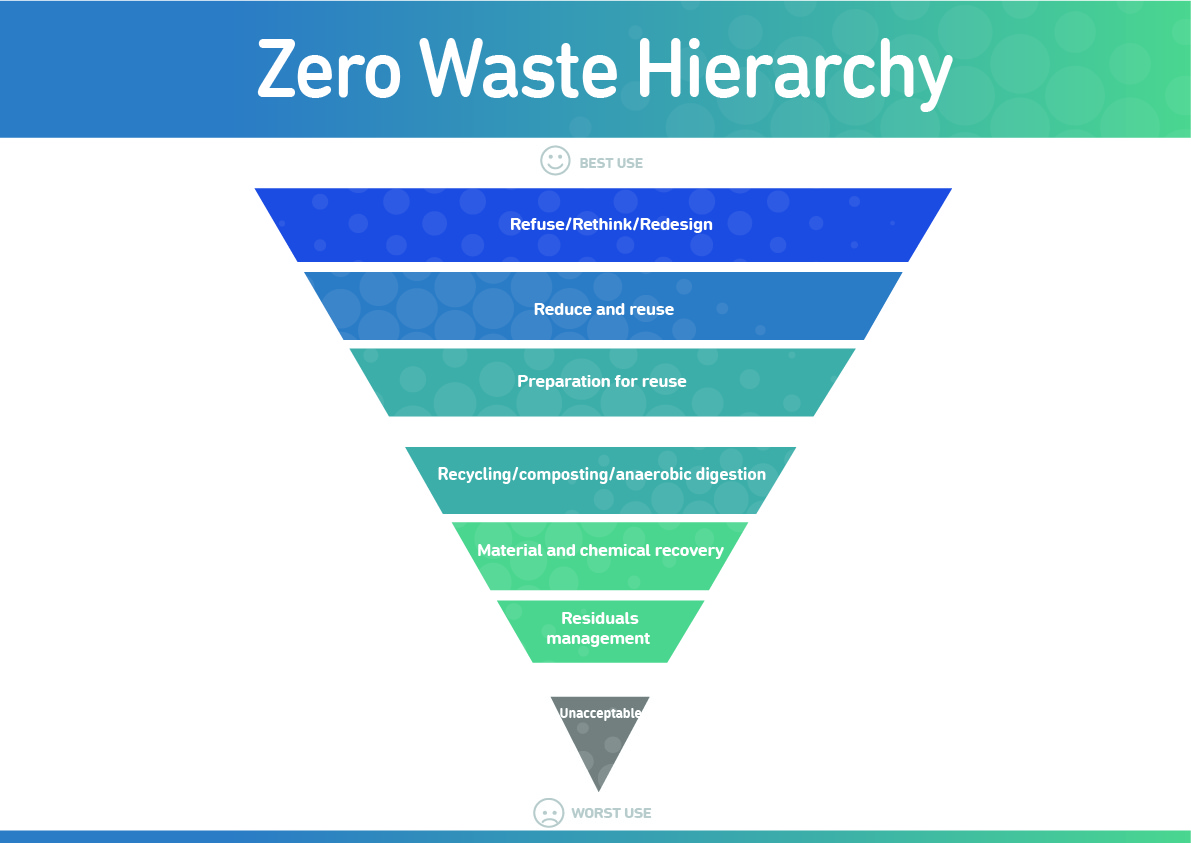
The circular economy model can be implemented by businesses in two ways that work in a complementary fashion between them- circular products and circular business models. Both ways are necessary and can be adopted by every businesses in every sector. A useful visual tool to prioritise options, is the waste hierarchy (below). We will refer to it throughout this section
What is a circular product?
Circular products are those that operate within the circular economy model i.e. those products that have reduced or completely no need for virgin resources and are designed with the end of their life in mind.
The majority of companies today design their products based on what their clients want in terms of functionality and aesthetics and produce them on the basis of cost. Once those products are sold and leave the premises, that is when the company's responsibility finishes. Circular products however are designed with radically different parameneters in mind. There is much more time spent in the design phase that reduce however the time and cost spent at the end of the product's life. The product is therefore more efficient, cost-effective and environmentally friendy thourgouht its life. The design phase does not differ from the waste management phase, they are all incorporated into one.
So an ideal circular product starts pretty much the same way that a conventional one does- with the clients' needs and expectations in mind. When we look at the product however, we have to consider which elements of it are actually necessary, as the first step in a Zero Waste economy, is to reduce materials as much as possible. Do we need lables on bottles? Maybe they can be engraved, mybe there can be a "bottle bank" that receives empty bottles, sterilises them and sends them back to the companies.
The next step is to identify which resources can be sourced from a stream that already exists in the economy for our essential parts- i.e. a non-virgin resource. Are we looking for recycled paper, upcycled office furniture, fixed IT equipment by default? Do we have the processes in place for that?
Next, we should consider how this resource is going to be used in the manufacturing process. Will we create a plastic product from recycled plastic but through the usual techniques, or maybe by 3D printing that reduces waste?
After this, we have to consider how the product is going to be used throughout its life. Is it likely that parts of it will break down? How can we replace them instead of creating a completely new product and have profit? Will the product ever be unusable, and in that case, how can it be processed, remembering that recycling is close to the bottom of the waste hierarchy.
When the product is designed, there are still many things that can be done for its delivery, which is where circular business models come in.
What is a circular business model?
"Circular economy business models keep products and materials in use, by design, for as long as possible to get the maximum value from them.
A circular economy approach ensures that materials are retained within productive use, in a high value state, for as long as possible. It focuses on reshaping business and economic systems so that waste is ‘designed out’ of how we live.
Examples of circular economy business models
Hire and Leasing- Hire or leasing of products as an alternative to purchasing.
Performance / Service System- Providing a service based on delivering the performance outputs of a product where the manufacturer retains ownership, has greater control over the production of a product, and therefore has more interest in producing a product that lasts.
Incentivised Return-Offering a financial or other incentive for the return of ‘used’ products. Products can be refurbished and re-sold.
Asset Management-Maximising product lifetime and minimising new purchase through tracking an organisation’s assets, planning what can be re-used, repaired or redeployed at a different site.
Collaborative Consumption-Rental or sharing of products between members of the public or businesses, often through peer-to-peer networks.
Long Life-Products designed for long life, supported by guarantees and trusted repair services." (from Zero Waste Scotland)
Many of these business models are already in use to different extents and different combinations- from Michelin's rented tyres to AirBnB's asset management-based model, resources remain in the economy for longer. With an increasing global population and decreasing resources, these models offer a roadmap for businesses to ensure financial stability, more control over prices and reduced negative environmental externalities. You can find some examples of local businesses implementing circularity in our Circular Tayside Map section.
If you would like to discuss how your organisation can adopt or create a circular economy product or business model, contact us and we will arrange for a chat as soon as possible. There is a wealth of information and support available for free. Join us in this transition today!